Introduction
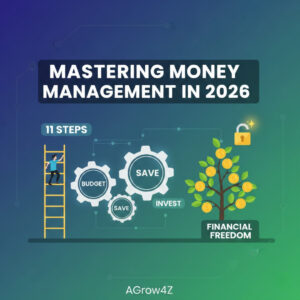
Mastering 2026 Finance with AGrow4Z: Expert tips on banking, credit, and money management to build your financial success in 2026.
Moving to the United States is a big life change. Whether you’re here for work, education, or to build a new life, one thing becomes clear very quickly: money works differently here. From credit scores to taxes, the U.S. financial system has its own rules.
These rules aren’t always easy to understand, especially if no one has taught you. And even if you haven’t just moved to the US, chances are you weren’t taught a whole lot about money. But don’t worry.
US Banking System
If you haven’t already opened a bank account in the U.S., it will probably be one of your first steps. Most employers pay you through direct deposit, which requires at least a checking account.
You’ll also need it to pay bills, shop online, and avoid carrying large amounts of cash. There are typically two types of accounts you’ll encounter: a checking account and a savings account.
A checking account is for daily use. This is where your paycheck goes and how you pay for most expenses using a debit card. A savings account is to store money you don’t plan to spend right away.
Some savings accounts offer interest, but usually very low. Now you’ll often hear about high yield savings accounts. These are generally offered at online banks, like Ally and Marcus of Goldman Sachs.
Because they don’t have physical brick and mortar stores, they’re typically able to offer higher yields. As of the middle of 2025, normal savings accounts like Chase are offering .01%, but Ally is offering something closer to 3.5%.
A couple of things to keep in mind when you’re looking for a bank account. Monthly fees: Some banks charge if you don’t meet minimum balances or deposit requirements.
ATM access: If you use ATMs outside of your bank’s network, you may incur fees. Try to stick to your bank’s ATM network to avoid these. Often times, using online banks or credit unions can mitigate almost all of these fees.
They can typically offer no-fee checking, and better savings rates, as well as having lower fees in general.
Credit Scores
In many countries, cash is king. But in the U.S., credit is power.
What is a credit score? It’s a number between 300 and 850 that reflects how well you manage borrowed money.
It’s broken down into 5 main categories. Credit history length (15%) – How long you’ve had credit accounts. Credit mix (10%) – Do you have different types of credit like a card or loan?
New credit (10%) – How many recent accounts have you tried to apply for and open. Too many applications can hurt your score temporarily. So how can you start building your credit?
You want to have credit and start paying it off in full each month to show history. You could start by getting a secured credit card. This type of card requires you to provide a cash deposit.
It also helps you get lower interest rates, and even housing opportunities.
Taxes
Taxes in America are complex, vary by state, and by person, but here’s what you need to know upfront. There are different types of taxes: Federal income tax and State income tax.
Federal income tax is paid to the U.S. government and taken out of your paycheck automatically. State income tax: Some states like California and New York also take a cut.
Others like Texas and Florida don’t. Sales tax is added to most purchases, usually between 5–10%, and varies by state. Property tax: If you purchase a home, you’ll pay this yearly based on its value.
Even if you are not a citizen, you likely still have to file if you work in the U.S. Depending on your income and withholdings, you might receive a tax refund.
Payment Methods
As we mentioned in the banking system, you’ll quickly notice that most people don’t use cash. Instead, payments are digital, fast, and sometimes tricky. The most traditional ways to pay have been through debit and credit cards.
A debit card is linked directly to your checking account. A credit card uses borrowed money and can help build credit if used responsibly and paid off on time. Now, we have additional digital apps.
When you’re in a tricky situation, these quick loans can seem helpful, but they’re built with outrageous fees and interest. Buy Now, Pay Later loans (BNPL) are also common.
These modernized “layaway” plans are built around paying in installments with no interest added. If used wisely, they can be good, but they often lead to overspending and debt.
To make it simple, stick with debit or credit, use a budget whether written down or an app, and always read the fine print.
Financial advice
You can set limits so that when large chunks of money enter or leave, you receive an email or text. Use strong passwords and enable two-factor authentication on all financial apps.
We know it’s tedious, but do not use the same password for your financial accounts as you use on other accounts like Netflix. Also, never feel embarrassed to ask questions at the bank.
One Step At A Time
It’s easy to feel overwhelmed when you’re new to the American financial system. But breathe, no one knows everything in the beginning. Most of us learn as we go. The main thing is to focus on certain areas.
Start by setting up a secure bank account. Then, learn about credit and start building your credit. Understand how taxes and spending work. Finally, stay away from financial traps.